Showing posts with label harry potter. Show all posts

Thursday, December 14, 2017

Seven Things: Harry Potter

Seven Things About:
HARRY POTTER
By Paul Adams
            Works of fiction can often be difficult to get into, and latecomers to the game can often be confused by the sheer amount of lore and plot built into something ongoing. So, I’m here to break down what one needs to know into seven easy-to-understand plot points, followed by what, in my opinion, are the seven strongest points of the work as well as the seven weakest. That way, a new reader or viewer has some sense of what they are about to get themselves into. What are we covering today? The Harry Potter series by J.K. Rowling

1.     This is Harry Potter: He is a bright and kind young boy who has had the misfortune of being raised by an abusively neglectful aunt and uncle, who even forced him to sleep in a cupboard for the first ten years of his life. But on the day he turns eleven, he discovers that . . .
2.     He lives in a world of magic and wizards: That’s right. He finds out that a whole other world full of magic and wizards and witches has been existing in secret right alongside the world of ordinary people (otherwise known as Muggles). People fly on brooms, cast spells with magic wands, and all sorts of magical things.
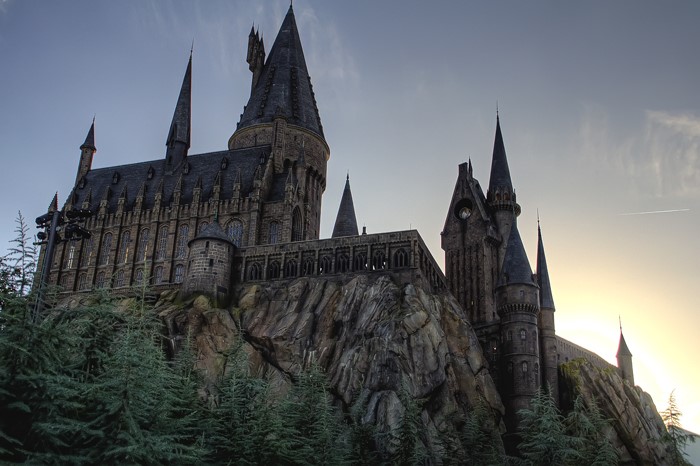
3.     He attends a school named Hogwarts: At age eleven, wizarding children attend Hogwarts School of Witchcraft and Wizardry, under the tutelage of the wise old headmaster Albus Dumbledore. While there, they take classes on transfiguration, potions, divination, care of magical creatures, defense against the dark arts and so much more. They are also sorted into one of four houses: Gryffindor, Hufflepuff, Ravenclaw, and Slytherin.
4.     Ron and Hermione are his best friends: Once he arrives at Hogwarts, Harry makes many friends, most notable of whom are Ronald Weasley and Hermione Granger. Ron comes from a wizarding family with lost of siblings, and he teaches Harry the ins and outs of wizarding society. Hermione, on the other hand, is a Muggle-born bookworm who taught herself all the intricate complicated details of magic itself.
5.     The wizarding world lives in fear of Lord Voldemort: We quickly learn that at the time Harry was born, the wizarding world lived in fear under the tyrannical reign of Lord Voldemort. For unknown reasons, he attacked and killed Harry’s parents and attempted to kill Harry only for the spell to backfire, causing Voldemort to disappear, leaving Harry with only a lightning-shaped scar. Rumors abound that Voldemort is still out there somewhere.
6.     A heavy anti-Muggle sentiment pervades the Wizarding World: Much of Voldemort’s power came about through the strong anti-Muggle feelings of many in the Wizarding World, most notably through many wizards that came from Slytherin house in Hogwarts. This leads to heavy persecution of many Muggle-borns at the school, including Hermione.
7.     There are seven books: A good thing to know is that this series is made up of seven books in total, centering on each of Harry’s years at Hogwarts. They generally feature a few chapters of the summer months leading up to Harry’s return to school, the beginning of his school year, important events occurring around Halloween and Christmas, and the climax taking place around the end of the school year. Movies have also been made of every book.

And now, here’s just a few of the things I like most about the series:

1.     The Characters: If one thing stands out about the series, it is the enormous number of well-developed, nuanced, and beloved characters in the series. Harry, Ron, and Hermione are all strong characters in their own right, as well as many fellow students such as Neville Longbottom and Luna Lovegood. The teachers and staff of the school, such as Professors Dumbledore, McGonagall, and Snape and the gamekeeper Hagrid, are also strong characters, with a major character being introduced in each book via the constantly shifting Defense Against the Dark Arts position. Outside of the school, we meet many other wizards, such as Ron’s family or the Order of the Phoenix, all of whom make for a complex world of vibrant characters who feel as real as any person in real life.
2.     The World-Building: If you are an aspiring author and read these books for only one reason, that reason is world-building. Many consider the series a master class in the subject. The first book does a solid job of capturing the wonder and fantasy of such a world and school, but each book builds upon the last, with each installment introducing you to: how a wizarding family lives (book two), the wider international wizarding world (book four), the inner workings of the wizarding government (book five), and so on.
3.     The Steady Maturation Level: This series was first introduced to elementary and junior high students as a fun, fantastical adventure of wizards and spells and magical creatures, and the first book maintains a childlike whimsy to it. As the books go on though, they are carefully matured to grow with the generation who started reading them, each one becoming more and more adult as they went. The second book was still whimsical, but also brought in a stronger focus on the anti-Muggle bigotry of the wizarding world. The third dealt with an escaped murderer, only to find that things were not quite as clear cut as they seemed. The fourth featured the return of Lord Voldemort and the first real death in the books (of one of Harry’s fellow students, no less). The fifth featured a corrupt and unreliable government, and a cruel, vindictive authority figure in Dolores Umbridge. The sixth explored the past of Voldemort, previously only seen as a two-dimensional bad guy, and featured the murder of Dumbledore at the hands of fellow teacher Professor Snape. Then we have the seventh book, which follows Harry, Ron, and Hermione as they become fugitives of the law, Voldemort overthrows the government, enacts discriminatory laws against Muggle-borns, the death toll reaches into the thousands, including several named and beloved characters, and the previous assumptions of characters such as Dumbledore and Snape are bucked entirely.
4.     The Creativity and Imagination: One thing the series is in no short supply of is endless creativity. From sports played with magic brooms, to jelly beans of every flavor imaginable, to house-elves and centaurs and mermaids and dragons, J.K. Rowling’s books feature a world full of magic, magical creatures, and magical institutions that get the mind racing with all the possibilities and wonders such a world could possibly hold.
5.     Depth of Themes and Issues: Related to the maturation point above, but not entirely, another thing these books excel at is the depth to which the various themes are explored. Hatred and bigotry of course are explored, not only through the Slytherins and their anti-Muggle sentiment, but also through Muggles like Harry’s aunt and uncle in return. We also explore themes like coming of age, as Harry grows and matures throughout his years at Hogwarts; learning to see past initial assumptions, as many characters prove to be far more than they seem as first presented (i.e. Dumbledore, Snape, Voldemort, Aunt Petunia, Sirius Black, and so many others); and loss, as we see Harry come to terms with losing friends, parental figures, mentors, and so many others.
6.     Subtle Layers for Re-Reading: One thing I’ve noticed as I read and re-read these books is that I always pick up something new with each readthrough. Snape’s actions suddenly take on a whole new light once the final reveal about his character is given in the last book, and many of Dumbledore’s actions make you see him differently once you know all there is to know about the character. You may also pick up on subtle actions by minor characters throughout the books that you didn’t pick up on the first or second or even third times. Ron’s mom, for instance, becomes a better and better character every time you read her.
7.     Accessibility: And finally, one of the greatest strengths of this series is just how accessible it can be to readers of all ages. While most of the later books are massive, it uses simple, easy language that doesn’t bog down the reader and always keeps them entertained. Likewise, the series is kept firmly at seven books, so one can easily pick up the first and read them through without too much trouble.


Now, even though I don’t really have much negative to say about the series, for the sake of balance and fairness, here’s seven things I don’t care for.

1.     S.P.E.W.: Toward the fourth book, Hermione becomes aware of the plight of the house-elves, who are more or less enslaved by many in the wizarding world. She then takes it upon herself to found the “Society for the Protection of Elfish Welfare,” using it to bully and intimidate many of her fellow students and attempt to free the elves, sometimes against their own wishes. While the sentiment is fine in theory, it tends to be very poorly executed and often drags down the story.
2.     The Romance Department: The Harry Potter series is strong for a thousand different reasons, but one should not go into it expecting a good romance. The final couples of Ron/Hermione and Harry/Ginny (Ron’s little sister) both tend to leave a little to be desired, even if you supported the pairings, and many feel Harry/Hermione would have been a better couple. Even outside of those couples, Harry and Ron’s relationships with their first girlfriends Cho and Lavender came off as annoying and aggravating at the best of times. The best romances in the story (such as Lupin and Tonks) mostly happen offscreen and are only known by Harry when they affect the plot in some way. If that’s what you’re going in for, you’re going to be disappointed.
3.     Character Mood Swings: When your main characters are teenagers, this is bound to happen, and probably should happen, but that doesn’t make it any more enjoyable when it does. Throughout the books, Harry, Ron, and Hermione have their periods when they are emotional, rude to everyone around them, and liable to fly off the handle at a moment’s notice. Harry is especially prone to throwing enormous temper tantrums throughout the fifth book, and Ron has his bouts of being a generally awful person in the fourth, sixth, and even a bit of the seventh book. Hermione can often be preachy, judgmental, and condescending to her friends and will occasionally stop speaking to them for months at a time. Again, part of their character development, but it can turn you off real quick.
4.     The Movie Effect: Movies will always be a bit better known to the general public than books. It’s a little easier to watch a two-hour moving picture than it is to read a three-to-seven-hundred page book. That’s just how it is, and it is probably why live-action blockbuster movies are sometimes treated as the be-all-end-all of a given work. That said, the movies made of this series did a relatively decent job adapting the story (at the very least, the casting was nearly perfection), but not a perfect job, and the little imperfections here and there built up over time, so that the final picture was more a shadow of the books than a real representation of the books. For many who have only seen the movies, this can often tarnish their opinion of the series as a whole.
5.     The Dursleys’ Cartoonish Behavior: Now, while I said earlier that Harry’s aunt and uncle presented the hatred of Muggles for the wizarding world, far too often, they are more cartoony stereotypes than anything. They fit in well with the whimsical world of the first book, as their over-the-top neglect and obsession with normalcy was just as weird as anything else in the world, as the books grew and matured, the Dursleys’ behavior became more and more out of place in the story, to the extent that the movies tended to ignore them almost entirely in later installments.
6.     Occasional Plot Contrivance: These are mostly the surface-level complaints that you’ve probably all heard once or twice before. “Why does September 1st fall on a Sunday every year?” “Why is it that every major thing that happens to Harry doesn’t come to a head until the end of the school year?” So on, and so forth. To be honest, the books are so full of nuance, depth, character, and intricately layered detail that I find it hard to even really care about superficial stuff like this.
7.     Popularity Backlash: It happens to the best of them. When something gets really, really popular really, really fast, there always crops up that counter-culture element that becomes determined to hate it on sheer principle of “not following the crowd.” Back when this was first popular, I was a little kid and I fell into this trap with not only this but Pokémon too. It didn’t last long though, and as I grew up, that experience gave me enough self-awareness to try to avoid doing that with anything else. It’s still an easy trap to fall into, and one always has to take a step back and ask themselves why they are hating on it. Sometimes, you still do, but it’s for more substantial reasons than just “I hate it because everyone else likes it.”

Thanks for reading. All images drawn from Google Images. Comment below and follow me for more.

Thursday, November 30, 2017

Journal: Bechdel Test

Journal: The Bechdel Test
By
Paul Adams
Whoa!
Whoa!
Calm down. This isn’t what you think. Either of you. No, I’m not going to shove some half-thought-out feminist rage down your throat, and no, I’m not going to go on a “mansplaining” rant about everything I’ve decided is wrong with feminism either. This is a simple and honest discussion of a commonly used trope that just so happens to often be used by proponents of feminism and what it really tells us about writing.
For those who don’t know, the Bechdel test was created in 1985 by Alison Bechdel and has since become a common test for gender bias in fiction. The test, in a nutshell, says that a work must feature at least two female characters, those characters must have names, and they must have a conversation not centered around men. Now, as a general rule, this test should never be seen as a definitive test for what is sexist, what is feminist, or otherwise. Hundreds of films and books don’t pass the test that are far more positive and progressive in their depiction of women than hundreds of films and books that do. The test is far too general and loose in its criteria to ever be considered a definitive test. What it does do, however, is shine a light on easy and common mistakes to make for a writer or creator.
To really understand this test, I looked at as many works as I could through the lens of both a Bechdel test and a reverse Bechdel test (basically the same thing but with guys), and I noticed a few specific trends. First and foremost, the sex of the protagonist is almost always a factor in whether or not the work passes either; specifically, if the protagonist is male, the work is less likely to pass the regular Bechdel test, but if the protagonist is female, the work is less likely to pass the reverse. However, if the work has multiple protagonists (of equal importance), maybe a duo or an ensemble cast, the work is almost always going to pass both. Secondly, no matter the gender of the protagonist, the longer the work runs, for several books, movies, episodes, etc. the more likely it will pass both tests.
These say a bit more than you think. Most importantly, they speak to the real power of a protagonist on a story. Our protagonist is our main anchor in the narrative. Everything we see and hear is filtered through them. Every supporting character and their interactions will be structured around their direct relationship to the protagonist. The more time we spend in this world, the more those supporting characters will be fleshed-out and their interactions won’t have to be directly linked to the protagonist, but if the work is only a single installment, those supporting characters will have a much smaller window of time to reach that level.
The Harry Potter series is an excellent example of this. If one applies the Bechdel test to the first book, Harry Potter and the Philosopher’s/Sorcerer’s Stone, it is negligible at best if it passes or not. At this point, we are just being introduced to the wizarding world and Hogwarts, and everything is being filtered through Harry’s eyes. The entire cast, including the female cast, exist primarily through their relationship to Harry. Petunia is Harry’s abusive aunt, Hermione is one of the friends Harry makes at school, and Professor McGonagall is one of his teachers. Other female characters inhabit this world, but these three are the most prominent. The most conversation had between any of the three is maybe a few passing comments during class between Hermione and McGonagall.
However, by the end of the series, a full six books later, the series has passed the Bechdel test maybe a thousand times over. Among our strong female cast are Hermione, McGonagall, and Petunia, alongside Molly and Ginny Weasley, Professors Sprout, Trelawney, and Madam Pomfrey, Luna Lovegood, Bellatrix Lestrange, Dolores Umbridge, Nymphadora Tonks, Fleur Delacour, Cho Chang, and so many others, all with a thousand different interests and drives, varying levels of morality and depth, and most of whom have had numerous conversations with each other on a number of different subjects. Conversations about men have occurred, obviously, the test says nothing about such conversations not happening at all (if it did, nothing would pass the regular or reverse tests). Considering half the cast is made up of hormonal teenagers, this is unavoidable. But we have also had conversations between Hermione and McGonagall on grades, McGonagall and Trelawney on their differing opinions of the Divination subject, McGonagall standing up to Umbridge on more than a few occasions, Molly and Tonks discussing Order of the Phoenix matters, Hermione and Luna arguing the merits of Luna’s crazy theories, and Ginny and Molly having regular mother-daughter conversations here and there. What made the difference was the time these seven books gave the readers to flesh out all the characters around Harry, something the first book never could have done.
The contrast I noticed between male and female protagonists and the results of their respective Bechdel tests is most noticeable in the action and romantic comedy genres, two genres I consider to be spear and distaff counterparts to each other. Both market themselves to one specific gender, both tend to feature a predominantly male or female protagonist respectively, and both pander to the basest stereotypical drives of their target gender. Both genres can be shallow, lazy, and cliché in both story and character at their worst and even most average moments, both tend to paint unflattering portraits of the opposite gender to their target audience, and both tend to be the worst offenders regarding the Bechdel or reverse Bechdel tests.
In an action movie, your protagonist is generally your Vin Deisel, Jason Statham, or Bruce Willis type: tough, witty, and occasionally versatile enough to use his brain as well as his brawn. All characters will be structured around him, be they his crew, the bad guys, his family, or the authorities presenting an obstacle in his path. The common female archetypes will be the sexy love interest, who will mainly talk to him. He may have a wife, daughter, mother, or sister who will drive his motivation in some way. There may be a Michelle Rodriguez type within the crew, or a sexy femme fatale among the bad guys. There can often be a tough female cop who has worked her way up through the ranks and won’t take crap from anyone and is the main authority getting in his way. Most of these characters are structured around the protagonist and his adrenaline-fueled adventure and most of their interactions will be with him. If he has more than one female family member, they will probably have a familial conversation, thus passing the test, and if there is more than one woman on his crew, chances are they will talk business at some point, but in general most of these archetypes are rarely in a position to interact much at all.
On the flipside, we have the Rom Com. Our female protagonist will often be a smart, driven businesswoman who has built a very successful life for herself and has everything she could ever want, now if only she could find her true love. You know, a Katherine Heigl, Lacey Chabert, or Michelle Monaghan type. The male cast will be predominantly made up of the dashing, generically handsome love interest with a square jaw and zero personality. He will probably have a friend, with whom he will discuss nothing but women. Our female lead may have a gay coworker, or a male boss who will probably sexually harass her at some point in the movie, and just like the action genre, she may have a family: a brother or a father and so on. If she has multiple men in her family, they will likely have a familial conversation and pass the reverse test. If her father and brother interact with the love interest at all, it will only be about the protagonist. There may also be a smarmy jerk of a rival love interest, whose interactions with his opponent will likewise only consist of discussion of our leading lady.
Now, both of these genres are no stranger to the opposite gender in the lead role, and I tend to find these archetypes still remain, only in gender-flipped form depending on the role, and the reverse rules still apply. However, when these genres both have dual protagonists of equal prominence in the plot, they will tend to pass both the regular and reverse tests, as both protagonists will have multiple conversations with the people of both genders in their lives.
An interesting case in this regard are the classic Disney princess films. In the case of Cinderella, the male cast can be summed up to primarily Jaq, Gus, the King, the Prince, and the Grand Duke. The latter three arguably already fail the reverse test, as they do not technically have names that the viewer knows of without having to resort to supplementary material, while Jaq and Gus just barely manage to eke out a passing grade. Even though about ninety percent of their conversations center around their beloved “Cinderelly,” they do manage to get in a few lines to each other about Lucifer the cat and how to be a mouse. Then, if you wanted to overlook the King and Grand Duke’s lack of names, they do have several conversations . . . about the prince . . . specifically finding a wife for the prince.
On the other hand, Snow White and the Seven Dwarves, while having a female protagonist, does pass the reverse test with flying colors, given the titular seven dwarves, each with a name, all have conversations with each other about mining and stuff. However, if one were to condense the dwarves down into a single character, make it Snow White and the One Dwarf, suddenly the movie does not pass anymore, as the dwarf, the Huntsman, and the Prince would barely even interact with one another (also the Huntsman and Prince don’t have names given in the movie either). I find another common trend seems to be that despite the gender of your protagonist, if you have more than one of the opposite gender in a group that share a single attachment to said protagonist, like the dwarves in Snow White or the family members in the action and rom com genres, then the test, regular or reversed, will generally be passed.
Finally, we come to TV series, which almost unilaterally pass both versions of the test due to A) the longer amount of time allotted, giving them the advantage spoken of earlier, and B) more often than not having ensemble casts who will mix and match with each other episode by episode. Friends, for example, featured a six-person cast of three girls and three guys, none of whom had any particular prevalence over the others, so every episode, we watched our six protagonists interact with each other, guys and girls alike, and with other characters around them, and no one even needed to consider a test. Ensemble casts pose other problems, especially in formats outside of television, so don’t go away from this thinking that that’s going to just be a cure-all to every Bechdel-related problem.
On the whole, if you’re really concerned about passing the Bechdel test, consider the medium with which you are working. An ensemble cast works well for television, and has worked on other mediums in the past, though it comes with a lot of problems you are going to have to work around. Dual protagonists work best in film, but generally work fine in book form as well. A single protagonist generally proves to give your story the strongest focus of all these options, though it does carry with it the limitations covered above. If you want to write or create a long-running series, use that time wisely to flesh out all of your characters and the problem will work itself out. If you want to write a single, stand-alone story, realize that time is not on your side, and your safest bet is to write multiple characters of opposite gender to the protagonist making up a group with a shared relationship to the protagonist.

If you aren’t worried about passing the Bechdel test, or the reverse for that matter, that’s fine too. It is not, and never will be, an accurate reflection of what is or is not sexist, or what is or is not feminist. It primarily functions to highlight inconsistencies that result as a natural part of the limitations of writing or the imperfectness of the human condition. If nothing else, through the course of this essay, the Bechdel test has demonstrated just how powerful an effect your protagonists can have on everything else in your story. Use them wisely.

Thanks for reading. Comment below and follow me for more.

Thursday, November 23, 2017

Journal: Generic Everyman Protagonist

Journal: Generic Everyman Protagonists
by
Paul Adams
So, today I want to talk about the “Generic Everyman Protagonist” common in fiction, or for sake of brevity, the G.E.P. The most notable representatives pf this of course being Harry Potter, Percy Jackson, Frodo Baggins, and Luke Skywalker in movies and books, and most of the protagonists of video games. Now these characters can come in all shapes and sizes, though they are often the most common ethnicity in the country of the work's origin, and are often male though there are more than a few females in this role ( a surprisingly high amount in manga and anime, see: Lucy in Fairy Tale). Hence the reason for the four examples listed above all being white males as they are the best known to an American audience. I will be getting into this more later.
Now, the “Generic Everyman Protagonist” exists primarily in the science fiction or fantasy genre but can crop up in other genres. Their purpose in most cases is to give the audience a “lowest common denominator” of sorts to relate to, a center of stability and familiarity to see this strange new world through. In some ways, the basic-ness of their character is their greatest strength. If you are trying to show your audience this vast world or concept that you’ve created, you don’t want them to be constantly distracted because their proxy in the world has way too much going on.
Before I get started, there are a couple of troublesome factors involved. Like I pointed out earlier, many of these types of characters are often white straight males (in Western media, at least). Whether this is whitewashing or social whatever is not something I want to tackle here, but it does feed into the concept brought up in the preceding paragraph, about them having too much going on. Often, but not always, if your protagonist is female, she tends to carry into the story a certain degree of feminist angle. Instead of being first and foremost an observer of the world around her, most of the audience will want her to be a role model, an action hero, the center of the plot's attention at all times, and the writer will factor that in, and as a result, the world that they're supposed to be showing us will not be as developed. The same can be said for a dark-skinned protagonist, homosexual protagonist, or otherwise. Whether you support the causes or not, this can the quickest way to distract from the world you’re trying to present, or such characters and issues can be easily mishandled and authors will avoid them just so they don’t cause more problems. That said, that trend seems to be changing as “G.E.P.s” such as Katniss Everdeen of The Hunger Games and Rey and Finn of the newest Star Wars film did a solid job of filling their role without getting bogged down in these ways.
Another point of contention arises when you use this kind of character to explore other real life cultures, to present a culture your intended audience may not be familiar with by using a G.E.P. they can relate to. Such examples are The Last Samurai and Dances with Wolves. These kinds of stories will often be criticized for “racial appropriation,” especially if the G.E.P., rather than simply experiencing this culture they’re unfamiliar with and connecting to it, rises through the ranks of the culture and becomes their “best” member, their chief or chosen one or hero. This is understandable in some respects, as the hierarchy or fighting styles of the culture are often an important part of said culture, and letting the G.E.P. rise through the ranks lets them experience the culture on all levels, and narratively, it can give structure or purpose to your plot. I think, in the end, it just requires balance. And even if you take them to the upper echelons of the culture, try to avoid placing them at the very top if you can.
Now that the touchy subjects are out of the way, let’s focus on what makes Harry, Frodo, Percy, and Luke work but not others. I think it is a common misconception that because your protagonist is a G.E.P., that means that you don’t have to try with their characters. That you can just place the character in position, have them say the right things and ask the right questions, and that’s it. But I think it’s the opposite. I think the G.E.P. may be the most important character to get right. If you are supposed to experience the world through their eyes, then you are going to need them to be as human as they possibly can be. They need to feel the world around them. They need to care about the world around them. If the reader is to truly live within the world the author is presenting them, they need to feel it the way the G.E.P. character feels it. If the protagonist is simply walking through this “interesting world” of theirs and just kind of staring at it all without feeling any of it, the reader is not going to feel any of it. Although the G.E.P. may have the least going on, plot and characterwise, they need to be the most vibrantly human character in your story. Because in the end, the plot and world is their story, so they have to fill it with every ounce of emotion and feeling that they can.
Harry, Frodo, and Percy were all book characters first, so we were in their heads more than in other mediums. The world of Hogwarts only came to life for readers because it came to life for Harry. After living his life in a broom cupboard, the astonishment he felt exploring every last inch of his new magical world exceeded what would have been felt by almost anyone else, and that wonder came across in every last detail he took in. Frodo had lived his entire life in the sheltered community of the Shire, so every step he took beyond it was filled with terror and uncertainty about this vast world far different from his idyllic home. Percy had a wit and charm to his narration that colored the world that he explored, easing the tension that came with his cliché story arc and ensured that the old Greek myths he stumbled across were firmly translated into something a modern audience would understand.
Luke Skywalker on the other hand is a movie character first and foremost, and so the audience is not inside his head as much as they were inside Harry’s or Frodo’s or Percy’s. But the same principles still apply. Luke was a dreamer, a man who had lived his whole life on a barren farm, and could only imagine what was beyond the stars. When he stepped beyond his world, he was constantly learning and interacting with his new world. Though sometimes he was whiny and stubborn about learning it, he still had a sense of wonder and curiosity that allowed him to see as much of it as he could.
Now, I want to talk about the history of the G.E.P. in video games because theirs is an interesting history. For up to about the turn of the last century in video games, the sole purpose of the game was the gameplay mechanics themselves, and any plot was kept as basic as possible. This is the main reason for the longevity of the character Mario, as his creator Shigeru Miyamoto has continually gone out of his way to keep Mario as basic as possible, focusing on gameplay first, and simply adjusting him to fit whatever new game mechanics they came up with. Some games ended up as duds, but none ever truly hindered Mario’s success overall. Other games trying to compete with Mario, such as Sonic or Bubsy, were created as marketable characters first, and then had games built around them, and their success was often hindered by that fact.
Other games, especially the Role-Playing Game genre and occasionally the Action Adventure genre, including such franchises as Pokemon, The Legend of Zelda, and Final Fantasy, will intentionally go out of their way to make the player character as generic and unremarkable as possible, letting you name the character yourself and never having the character talk, so that you, the player, can then fill the character with your own personality and interests, so that you can “role-play” as them, if you will. In some ways, this is the best use of the G.E.P. for the video game genre, as the purpose of a G.E.P. in the first place is to give the audience someone to explore the world through, and in an interactive medium such as video games, you are the one exploring the world, so adding unnecessary personality will just get in the way more than it will help.
Around the turn of the last century, late 1990s to early 2000s, video games started to become far more cinematic as technology improved and creators were able to do more with what they had, and characters became more human and fleshed out than simple iconic cartoon animals. As more and more intricate stories and depth were added, video games became more akin to movies, but with an added element of your own involvement. This led to an interesting growth in the G.E.P. as creators learned new ways of giving the main character personality while allowing the player to still explore the world in their own way and make their own choices. Some games, such as Mass Effect and Undertale, featured massively branching storylines that made every choice you make matter, and no single playthrough of the games was ever the same twice, and the personality of the player character was slightly altered in each storyline to match the choices the player made, ranging from complete monster to noble hero and every shade in between. Interactive storytelling in video games has changed the G.E.P. into a fusion of generic and complex by allowing the player to determine just what kind of person their character is.

So, this has been a wide look at the “Generic Everyman Protagonist” and the problems and qualities contained therein, and the way they have impacted and been impacted by the mediums they appear in. They are something to remember for my writing, especially as Gavin bears many similarities to these types of protagonists. I don’t know if books or movies will ever be able to accomplish the same kind of level games have taken G.E.P.s to, but I suppose that’s why we have these different types of mediums. But I think we can learn from all forms of storytelling in order to make our own better.

Thanks for reading. Comment below and follow me for more.

Thursday, October 12, 2017

Journal: Franchise Building

Journal: Franchise Building
by Paul Adams
            So, here’s a thought I had on trying to start on franchises. I was recently watching a video on the recent video-game-based movie Warcraft, a film that was received with less-than-enthusiastic reception as a messy and confusing film, that was however beautiful and full of immense detail perfectly recreating the world of World of Warcraft. Several comments I read tried to defend the film, as a “worldbuilding film”: a movie that did the work of creating the world of the story so that other movies later down the road could then move in and tell an actually good story.
            As I pondered this, I considered several other works in the same vein that worked or didn’t work. The original Star Wars and Fellowship of the Ring are two of the most notable examples, films that set up a world, but still remained solid films that could be enjoyed alone. Harry Potter and the Sorcerer’s Stone did the job as well, as a book, and for the most part, as a movie. Iron Man did this for the entire thirteen films and counting of the Marvel Cinematic Universe. Films such as Dragonball Evolution, The Last Airbender, Eragon, and most recently, DC’s attempt to catch up to Marvel with Batman v. Superman, did not.
            The theory I formulated I will call the “Burger Theory.” Imagine you go to a Burger Joint and order a burger. When your food arrives, you are surprised to find only the bottom bun on your plate. You complain to your server, but he assures you that the bun is simply there to set up your burger and that if you wait two to three more years, you will get a patty. Two years after that, you’ll get your entire burger. They tell you that they hope you’ll be willing to wait that long, promising you that the burger you get in the end will be more than worth it.
            A few days later, you go to a different Burger Joint and ask for a burger. Soon enough, you are served an entire burger, and the server tells you that if you enjoyed the first, you are welcome to order a second. You eat, and it’s . . . good? Bad? Either way, you got a whole burger.
            The problem with the “It’s a worldbuilding film” defense, is that that shouldn’t be good enough. A viewer, reader, or otherwise should never be forced to settle for just a bun, hoping a great burger will come years down the road. If you did that in an actual Burger Joint, you’d never get a repeat customer. Why then, as a writer, creator, or artist, would you expect anyone to do any different when it comes to a work of fiction.
            The Marvel Cinematic Universe has grown from a simple standalone film about the origins of Iron Man to a massive interconnected universe featuring thirteen plus films, each raking in millions upon millions of dollars with every single entry, two television series, and three critically acclaimed Netflix series. Much of this wouldn’t even be possible without that first Iron Man film. One of the most important pieces to the success of Iron Man was that it remembered to tell its audience a good story. It had a charismatic and engaging lead, a clever script, and a level of depth that left the audience feeling more than satisfied. The only clue the audience had that it was supposed to lead into a wider universe didn’t even come until the now-famous postcredits scene, in which Samuel L. Jackson’s Nick Fury appears to Tony Stark to talk to him about the “Avenger Initiative.” In a figurative sense, the servers waited until the patrons had finished up their delicious burger before approaching and offering them a little bit more.
            On the other side of that coin was DC’s Batman v. Superman. The history of DC films is a rocky one. For many years, the only movies based on DC characters were Batman or Superman films, half of which were often poorly received. Their greatest claim to fame was Christopher Nolan’s Dark Knight trilogy. Nearly any attempt they had made to branch out to other properties were often met with catastrophic failure, some few examples being Supergirl, Catwoman, and Green Lantern. During all of this, Marvel slowly built up their cinematic behemoth, dwarfing DC and leaving them far behind in the dust.
            Their latest Superman film Man of Steel was met with mixed reviews, but DC was done with being left behind by Marvel. In a risky and desperate move, they pumped millions of dollars into jumpstarting a combined universe off of Man of Steel’s groundwork, their first entry being what they thought would be a shoe-in with Batman v. Superman: Dawn of Justice. What we got instead was a tedious and messy movie, skipping several of the much needed steps Marvel had taken by building up their universe slowly over time, instead opting to throw as much at the screen as they could, shouting to the audience, “Hey, look, it’s Wonder Woman! Hey, look, we’ve got the Flash! Aquaman! Let’s throw in Doomsday and kill off Superman in the second outing, instead of way down the line as it should be! That’ll get us back up to Marvel’s level.”
            In a sense, DC gave us a plate chock-full of fries and chocolate sundaes and sodas and salads around a single bun, when all we’d wanted was a simple burger.

            In the end, works like Iron Man, Star Wars, Fellowship, and Harry Potter did not try to force their great expanded universes on anyone. They told an interesting story and left their audiences feeling satisfied and excited. They got their sequels because the viewers wanted more. They delivered their promised burger, and the audience came back for seconds. Movies like Batman v. Superman and Warcraft tried to feed their viewers a piece of a story, making grand shows about having much more to come without actually delivering in the first outing. When this comes to my writing, it reflects how I used to go about writing the story versus what I’m trying to do now. Originally, my first book was full of stuff that led into later books without necessarily going anywhere and getting the audience lost and confused. In my newest attempt, I am trying to focus on writing the first book and let it stand on its own, while having a plan for later books that all could work together as a whole once finished. It’s a fragile balance, but hopefully one I can pull off.

Thanks for reading. Follow me for more and comment down below.